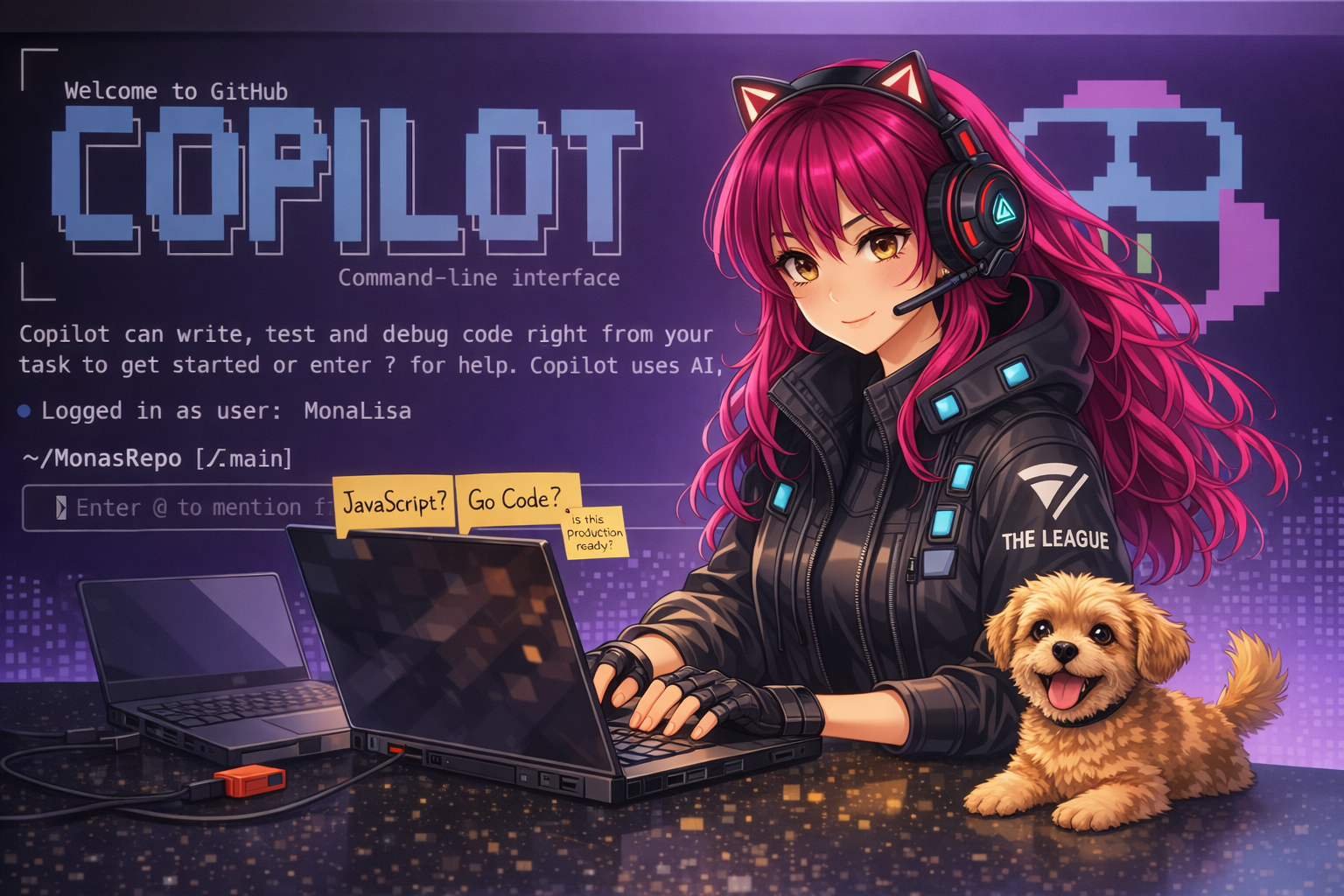
Welcome & AI-Assisted Development Landscape
ByteStrike's First Moment
ByteStrike sits at their desk, staring at the mission brief. The encrypted blueprints are waiting on a remote server. The deadline is real. And they've never written this particular piece of code before.
This is where most developers pause and think: "How do I even start?"
That's where GitHub Copilot comes in. Over the next few parts, you'll see how AI assistance transforms that moment of uncertainty into productive, iterative development.
The Rise of AI-Assisted Development
Artificial intelligence is fundamentally reshaping how we write code. GitHub Copilot represents a watershed moment in software development, a tool that brings AI pair programming directly into your IDE. Whether you're maintaining legacy systems, building new features, or exploring cutting-edge architectures, understanding how to work effectively with AI-assisted code generation is becoming essential.
This workshop is designed to take you from "What's Copilot?" to "How do I integrate this into my daily workflow?" We'll explore its capabilities, acknowledge its limitations, and equip you with practical techniques to use Copilot responsibly and productively.
Learning Objectives
- Set expectations for the workshop and understand what AI-assisted development means
- Recognize Copilot's capabilities as a code suggestion and generation tool
- Understand Copilot's limitations and when to rely on human judgment
- Learn the four interaction modes: Inline, Ask (Chat), Agent, and Plan, and when to use each
- Understand Copilot's three roles: Coach/Trainer, Pair Programmer, and Colleague to delegate tasks
- Identify where and how to use Copilot (inline editor, chat panel, quick chat, etc.)
What is GitHub Copilot?
GitHub Copilot is an AI coding assistant powered by OpenAI's large language models (specifically trained on public code repositories). It integrates directly into VS Code (or Codespaces), Visual Studio, JetBrains IDEs, and other development environments, providing real-time code suggestions as you type.
Key Capabilities:
- Inline Suggestions: Autocomplete-style code suggestions across Visual Studio Code, Visual Studio, JetBrains IDEs, Azure Data Studio, Xcode, Vim/Neovim, and Eclipse, with next edit predictions in select IDEs
- Copilot Chat: Ask coding questions through a chat interface available on GitHub.com, GitHub Mobile, supported IDEs, and Windows Terminal, with optional skill integrations
- Copilot Coding Agent: Assign GitHub issues to Copilot to autonomously make code changes and create pull requests for your review
- Third-Party Coding Agents: Use third-party agents alongside Copilot to extend functionality and integration
- Copilot CLI: Use Copilot from your terminal to answer questions, make local file changes, and interact with GitHub.com operations
- Copilot Code Review: Get AI-generated code review suggestions to improve code quality and catch potential issues
- Copilot Pull Request Summaries: Automatically generate summaries of PR changes, impacted files, and review focus areas
- Copilot Edits: Make changes across multiple files directly from a Copilot Chat prompt with edit mode (granular control) or agent mode (autonomous)
- Custom Instructions: Enhance Copilot responses by providing contextual details about your preferences, tools, and requirements
- Copilot Memory: Copilot deduces and stores useful repository information to improve quality of code changes and reviews
- Copilot in GitHub Desktop: Automatically generate commit messages and descriptions based on your project changes
- Copilot Spaces: Organize code, docs, and specs into Spaces that ground Copilot's responses in the right context for specific tasks
- GitHub Spark: Build and deploy full-stack applications using natural-language prompts integrated with the GitHub platform
Key Limitations to Keep in Mind
Copilot is incredibly powerful, but it's not a silver bullet. Understanding its constraints will help you use it more effectively:
- Hallucinations: AI coding assistants can generate plausible-sounding but incorrect code, including references to non-existent functions or libraries
- Limited reasoning: GitHub Copilot works best with clear context; complex multi-step logic may require human guidance. Pay attention, you are the human in the loop
- Security awareness: Copilot and GitHub provide a secure, well governed, compliant and privacy focused ecosystem, but it cannot do everything for you. You must review and test carefully
- Outdated knowledge: Model Training data has a cutoff date; newer APIs or frameworks may not be well-represented.
- Context window: AI Coding Assistants have a limited "view" of your codebase; large files or complex architectures need more human guidance
Understanding GitHub Copilot's Interaction Modes
GitHub Copilot offers multiple ways to interact with AI assistance, each suited to different tasks and workflows. Understanding when and how to use each mode is key to maximizing productivity.
The Four Core Modes
1. Inline Completions (Always Active)
This is Copilot's foundational mode: real-time code suggestions that appear as you type, directly in your editor. Think of this as your intelligent autocomplete that understands context at a code level.
- When to use: Writing routine code, completing patterns, generating boilerplate
- How it works: Type naturally; press Tab to accept, Esc to dismiss
- Best for: Function implementations, test cases, repetitive code structures
- Example: Type
function calculateTax(and Copilot suggests the parameters and implementation
2. Chat Mode - Ask (Conversational Q&A)
Open the Copilot Chat panel to have a conversation with Copilot. Ask questions, request explanations, or get guidance without modifying your code directly.
- When to use: Learning unfamiliar APIs, debugging, understanding existing code, getting advice
- How it works: Open Chat panel (Ctrl+Shift+I), type your question, get detailed responses
- Best for: "How do I...", "Explain this code", "What's wrong with...", "What are best practices for..."
- Example: "Explain how OAuth 2.0 works in this context" or "Why is this function failing?"
3. Agent Mode (Autonomous Task Execution)
Agent mode enables Copilot to autonomously search your codebase, read files, analyze context, and make multi-step changes across your project. It can read documentation, run searches, and understand your workspace structure.
- When to use: Complex refactoring, feature implementation, debugging across multiple files
- How it works: Prefix your chat message with
@workspaceto activate workspace-aware assistance - Best for: "Fix all TODO comments", "Update all API calls to use new endpoints", "Find and fix security issues"
- Example: "@workspace Refactor authentication to use JWT tokens across all controllers"
4. Plan Mode (Strategic Planning)
Plan mode helps you break down complex tasks into actionable steps before diving into implementation. Copilot analyzes your request and creates a structured plan you can review and execute step-by-step.
- When to use: Large features, migrations, architecture changes, unfamiliar territory
- How it works: Use planning prompts or activate plan assistance in Chat
- Best for: "How should I implement user authentication?", "Plan a migration from REST to GraphQL"
- Example: "Create a plan to add real-time notifications to this app"
Copilot's Three Roles in Your Workflow
Beyond modes, think about how you want Copilot to help you:
🎓 As Your Coach/Trainer: Use Chat and Ask mode to learn and understand
- "Explain this design pattern"
- "What are the security implications of this approach?"
- "Show me examples of testing async functions"
- Best practice: Ask follow-up questions, request examples, challenge the explanations
👥 As Your Pair Programmer: Use Inline completions and Chat for real-time collaboration
- Write comments describing what you want, let Copilot generate implementation
- Select code and ask: "Refactor this to be more readable"
- Iterate on suggestions: review, modify, test together
- Best practice: Stay engaged, review every line, improve prompts for better results
🤝 As Your Colleague (Delegate Tasks): Use Agent mode for autonomous work
- "@workspace Generate unit tests for all service classes"
- "@workspace Update all deprecated API calls"
- "Find performance issues in database queries"
- Best practice: Give clear requirements, verify results thoroughly, test changes
Where Copilot Assists You
- In the Editor (Inline): Real-time suggestions as you type, perfect for flow state coding
- In the Chat Panel: Side-by-side conversations while viewing your code, ideal for Q&A and planning
- In Quick Chat (Ctrl+I): Inline chat overlay for quick edits, use for focused refactoring of specific sections
- In Pull Requests: Copilot can review and summarize changes, great for code review preparation
- In Terminal: Copilot can explain commands and suggest shell scripts, helpful for DevOps tasks
Choosing the Right Approach
| Task | Best Mode | Role |
|---|---|---|
| Writing a new function | Inline | Pair Programmer |
| Understanding unfamiliar code | Ask (Chat) | Coach |
| Refactoring across multiple files | Agent (@workspace) | Colleague |
| Planning a complex feature | Plan Mode | Coach + Pair |
| Debugging a specific error | Ask or Agent | Coach + Colleague |
| Writing tests | Inline or Agent | Pair or Colleague |
Your Mindset Going Forward
The most successful Copilot users adopt a few core principles:
- Stay in control: You're the senior developer. Copilot is your junior developer. Review, question, and improve every suggestion.
- Be explicit: The better your prompts (via comments, variable names, and docstrings), the better Copilot's output.
- Choose the right mode: Start with inline for quick tasks, escalate to Chat for guidance, use Agent for multi-file work.
- Test everything: Copilot-generated code should pass the same scrutiny as any other code: automated tests, security reviews, code reviews etc.
- Iterate together: If Copilot's first suggestion isn't right, refine your prompt and try again. Use different modes if needed.
💡 Quick Start Tips
- Inline mode: Press
Tabto accept,Escto dismiss,Alt+]for next suggestion - Chat mode:
Ctrl+Shift+I(Windows/Linux) orCmd+Shift+I(Mac) to open Chat panel - Quick Chat:
Ctrl+I(Windows/Linux) orCmd+I(Mac) for inline chat overlay - Agent mode: Type
@workspacein Chat to activate workspace-aware assistance - Selection + Chat: Select code, right-click → "Copilot" → "Explain" or "Fix" for context-specific help
Lab1: Building the Blueprint Decoder
ByteStrike needs to fetch the encrypted blueprint. Let's help them start.
Setup
- Ensure Copilot extension is installed in VS Code (or Codespaces) - GitHub Copilot by GitHub
- Sign in with your GitHub account
Task 1: Build the Blueprint Decoder
- Set up Copilot extension in VS Code (or Codespaces) for Python and C#
- Create a new file:
blueprint_decoder.py(orBlueprintDecoder.cs) - Trigger Copilot to suggest a function that fetches a URL and returns the content
- Observe how Copilot understands the task from just the function name and docstring
- Optional step: Ask Copilot to extend it to print all lines containing
{*markers
This is your first taste of how AI assistance works in practice: not magic, but guided iteration.
Step 1: Understanding the Mission
The League stores encrypted blueprints as text files. Critical intelligence is hidden between {* and *} markers, surrounded by decoy information. Your decoder must:
- Read a blueprint file (local file or URL)
- Find all secrets marked with
{*and*} - Extract and display only the secret messages
Step 2: Test Data Setup
We've provided a sample blueprint file in your workspace: blueprint-data.txt. It contains fake technical specs with 5 hidden secrets. Let's decode it!
Step 3: Build the Decoder
Choose your preferred language and let Copilot help you build the decoder:
How to Work with Copilot Suggestions
Before diving into code, understand how Copilot works in your editor:
- Trigger suggestions: Start typing a comment or code, and Copilot will automatically suggest completions. Look for gray text appearing in your editor-that's a suggestion from Copilot.
- Accept a suggestion: Press
Tab(orEnteron some editors) to accept the suggestion. The gray text becomes permanent code. - Reject a suggestion: Press
Escto dismiss it and keep typing what you want instead. - Cycle through suggestions: If Copilot shows one suggestion but you want to see alternatives, press
Alt+[(orOption+[on Mac) to see previous suggestions, orAlt+]to see next suggestions. - Multi-line suggestions: Copilot often suggests entire functions or blocks of code. Accept the whole thing with
Tab, then refine if needed. - Partial acceptance: You can also type a few characters and let Copilot finish, or accept part of a suggestion manually.
- Watch the context: Copilot reads your comments, variable names, and previous code to understand what you want. Better context = better suggestions. The detailed comments you wrote in Step 2 help Copilot understand the task!
Create a new file: blueprint_decoder.py
Step 1: Import the regex module at the top (it's built into Python, no installation needed):
import reStep 2: Add a detailed comment describing the exact algorithm:
# Function to read a blueprint file and extract all secrets marked between {* and *}
# Example: League Blueprint contains {* AGENT_CODENAME: SHADOWMIND *}
# Should extract: "AGENT_CODENAME: SHADOWMIND" (without the markers)
# Uses regex pattern to find all occurrences
# Returns a list of extracted secrets
def decode_blueprint(filename):
Step 3: Inside the function, start typing the first line to trigger Copilot:
with open(filename, 'r') asAs you type, Copilot should start suggesting the rest. Press Tab to accept suggestions. Copilot should generate code to:
- Read the file content
- Use
re.findall()with patternr'\{\* (.*?) \*\}' - Return the list of matches
Step 4: Add test code at the bottom:
# Test the decoder
if __name__ == "__main__":
    secrets = decode_blueprint("blueprint-data.txt")
    print(f"Found {len(secrets)} secret(s):")
    for i, secret in enumerate(secrets, 1):
        print(f"{i}. {secret}")
Run it: python blueprint_decoder.py
Expected output: 5 secrets extracted from the file, including "AGENT_CODENAME: SHADOWMIND" and "VAULT_ACCESS_CODE: DELTA-7-7-ECHO"
Create a new file: BlueprintDecoder.cs
1: Start with the class structure:
using System;
using System.IO;
using System.Text.RegularExpressions;
using System.Collections.Generic;

public class BlueprintDecoder
{
2: Add a detailed XML comment (C# documentation format):
    /// <summary>
    /// Reads a blueprint file and extracts all secrets marked between {* and *}
    /// Example: {* VAULT_ACCESS_CODE: DELTA-7-7-ECHO *} extracts the code inside
    /// Uses regex pattern to find all occurrences
    /// </summary>
    /// <param name="filename">Path to the blueprint file</param>
    /// <returns>List of extracted secret strings</returns>
    public static List<string> DecodeBlueprint(string filename)
    {
3: Start typing the first line to trigger Copilot:
string content = File.ReadAllCopilot should complete ReadAllText(filename) and suggest the regex code. Press Tab to accept. It should generate code to use Regex.Matches() to find all patterns.
4: Add a Main method to test it:
    static void Main()
    {
        var secrets = DecodeBlueprint("blueprint-data.txt");
        Console.WriteLine($"Found {secrets.Count} secret(s):");
        for (int i = 0; i < secrets.Count; i++)
        {
            Console.WriteLine($"{i + 1}. {secrets[i]}");
        }
    }
Run it: dotnet run
Expected output: 5 secrets extracted, properly formatted
Create a new file: blueprint_decoder.js
1: Import the fs module at the top:
const fs = require('fs');2: Add detailed JSDoc comment:
/**
 * Reads a blueprint file and extracts all secrets marked between {* and *}
 * Example: League transmission contains {* EMERGENCY_PROTOCOL: NIGHTFALL_SEQUENCE_ACTIVE *}
 * Extracts: "EMERGENCY_PROTOCOL: NIGHTFALL_SEQUENCE_ACTIVE" (without markers)
 * Uses regex pattern with match() or matchAll()
 * @param {string} filename - Path to the blueprint file
 * @returns {Array<string>} Array of extracted secret strings
 */
function decodeBlueprint(filename) {
3: Start typing to trigger Copilot suggestions:
const content = fs.readFileSync(filenameCopilot should complete the line and suggest the regex matching code. Press Tab to accept suggestions. It should generate code using match() or matchAll() with the pattern /\{\* (.*?) \*\}/g.
4: Add test code at the bottom:
// Test the decoder
const secrets = decodeBlueprint('blueprint-data.txt');
console.log(`Found ${secrets.length} secret(s):`);
secrets.forEach((secret, index) => {
    console.log(`${index + 1}. ${secret}`);
});
Run it: node blueprint_decoder.js
Expected output: List of 5 extracted secrets
💡 Important: Understand Before You Accept
Never blindly accept code you don't understand. Copilot generates suggestions quickly, but your job is to verify they're correct and make sense for your mission. If you're unsure about any generated code, don't just accept it and move on.
Instead, use Copilot Chat to understand the code:
- Ask for verbose comments: "Add detailed inline comments explaining what this code does, line by line"
- Ask for an explanation: "Explain this function to me in detail" or select the code and ask in Chat
- Use the ELI5 approach: "Explain this like I'm 5 years old" - seriously, this works great when you're having a rough day and need a super simple breakdown
- Ask follow-up questions: "Why does this use regex instead of string methods?" or "What could go wrong with this approach?"
Copilot is your pair programmer, not your code generator. The best developers using Copilot are active, critical, and always asking questions. That's how you stay in control and learn.
Task 2: Add Error Handling
What if the file doesn't exist? Update your decoder to handle file errors gracefully.
Add this comment and function skeleton:
# Enhanced version with error handling
# If file doesn't exist, return an empty list and print an error message
def decode_blueprint_safe(filename):
    try:
        # Use the original decode logic here
Now let Copilot complete the function with try-except that catches FileNotFoundError.
Test it:
if __name__ == "__main__":
    # Test error handling
    secrets = decode_blueprint_safe("nonexistent.txt")
    print(f"Found {len(secrets)} secrets")  # Should print 0

    # Test normal operation
    secrets = decode_blueprint_safe("blueprint-data.txt")
    print(f"Found {len(secrets)} secrets")  # Should print 5
Add this comment and method:
    // Enhanced version with error handling
    // If file doesn't exist, return empty list and print error message
    public static List<string> DecodeBlueprintSafe(string filename)
    {
        try
        {
            // Let Copilot read the file and extract secrets like the original function
        }
    }
Test it in Main:
        // Test error handling
        var secrets1 = DecodeBlueprintSafe("nonexistent.txt");
        Console.WriteLine($"Found {secrets1.Count} secrets");

        // Test normal operation
        var secrets2 = DecodeBlueprintSafe("blueprint-data.txt");
        Console.WriteLine($"Found {secrets2.Count} secrets");
Add this comment and function:
// Enhanced version with error handling
// If file doesn't exist, return empty array and print error message
function decodeBlueprintSafe(filename) {
    // Let Copilot add try-catch for file errors
}
Test it:
// Test error handling
const secrets1 = decodeBlueprintSafe('nonexistent.txt');
console.log(`Found ${secrets1.length} secrets`);

// Test normal operation
const secrets2 = decodeBlueprintSafe('blueprint-data.txt');
console.log(`Found ${secrets2.length} secrets`);
💡 Keeping Your Output Clean:
As you progress through tasks, you'll notice your output gets cluttered with test code from previous tasks. To see only the output from your current task:
- Comment out previous test code (keep the `if __name__` line!): Select only the lines inside the
if __name__ == "__main__":block from previous tasks and comment them out. Keep theif __name__ == "__main__":line itself uncommented so your new test code has a place to live. - Easiest approach: Select the block of code you want to hide and press
Ctrl+/(orCmd+/on Mac) to toggle comments on/off - Or use separate sections: Keep all test code, but know that running the file will execute everything in the
if __name__ == "__main__":block
For Task 3, comment out the test code sections from Task 2 (keep the `if __name__` line). Your new display_secrets_report() call will replace them inside that same block.
Task 3: Format the Output
Make the decoder output more readable by adding a formatting function. Your mission report should look professional, not cluttered.
What You're Building
A function that transforms raw secret strings into a formatted, readable report with:
- Clear visual separators (border lines)
- Numbered list with proper indentation
- Summary statistics
- Professional presentation
Add this formatted reporting function to your decoder:
# Function to format and display secrets in a professional report
# Includes header, separator lines, numbered list, and footer
def display_secrets_report(secrets):
    """Display extracted secrets in a formatted report.

    Args:
        secrets (list): List of secret strings to display
    """
    separator = "=" * 50
    print("\n" + separator)
    print("🔐 DECODED SECRETS REPORT".center(50))
    print(separator)
    print(f"Total secrets found: {len(secrets)}\n")

    # Let Copilot suggest: format each secret with index
    # Consider: padding, alignment, special characters
    for i, secret in enumerate(secrets, 1):
        print(f"  [{i:2d}] {secret}")

    print("\n" + separator + "\n")
Complete the function: Let Copilot finish the formatting logic (the for loop section). Copilot should suggest alternating colors, padding, or fancy formatting.
Test your formatter:
At the bottom of your file, update your if __name__ == "__main__": block to call the formatter:
if __name__ == "__main__":
    secrets = decode_blueprint_safe("blueprint-data.txt")
    display_secrets_report(secrets)
Expected output:
==================================================
🔐 DECODED SECRETS REPORT
==================================================
Total secrets found: 5

  [ 1] SECURE_COMMS_PROTOCOL
  [ 2] AGENT_CODENAME: SHADOWMIND
  [ 3] VAULT_ACCESS_CODE: DELTA-7-7-ECHO
  [ 4] MEETING_LOCATION: SAFEHOUSE_BERLIN_CHECKPOINT_C
  [ 5] EMERGENCY_PROTOCOL: NIGHTFALL_SEQUENCE_ACTIVE

==================================================
Add this formatted reporting method:
    /// <summary>
    /// Displays extracted secrets in a professional formatted report
    /// with separator lines, numbering, and statistics
    /// </summary>
    /// <param name="secrets">List of secret strings</param>
    public static void DisplaySecretsReport(List<string> secrets)
    {
        string separator = new string('=', 50);
        Console.WriteLine("\n" + separator);
        Console.WriteLine("🔐 DECODED SECRETS REPORT".PadRight(50));
        Console.WriteLine(separator);
        Console.WriteLine($"Total secrets found: {secrets.Count}\n");

        // Let Copilot suggest: numbered list with formatting
        for (int i = 0; i < secrets.Count; i++)
        {
            Console.WriteLine($"  [{i + 1,2}] {secrets[i]}");
        }

        Console.WriteLine("\n" + separator + "\n");
    }
Test your formatter: Update your Main method:
    static void Main()
    {
        var secrets = DecodeBlueprintSafe("blueprint-data.txt");
        DisplaySecretsReport(secrets);
    }
Add this formatted reporting function:
/**
 * Displays extracted secrets in a professional formatted report
 * with borders, numbering, and summary statistics
 * @param {Array<string>} secrets - Array of secret strings to display
 */
function displaySecretsReport(secrets) {
    const separator = '='.repeat(50);
    console.log('\n' + separator);
    console.log('🔐 DECODED SECRETS REPORT'.padEnd(50));
    console.log(separator);
    console.log(`Total secrets found: ${secrets.length}\n`);

    // Let Copilot suggest: format each secret with padding and numbering
    secrets.forEach((secret, index) => {
        // Suggestion: use padStart for alignment
        const num = String(index + 1).padStart(2, ' ');
        console.log(`  [${num}] ${secret}`);
    });

    console.log('\n' + separator + '\n');
}
Test your formatter: Update the code at the bottom of your file:
Replace your existing test code with this:
const secrets = decodeBlueprintSafe('blueprint-data.txt');
displaySecretsReport(secrets);
Run it: node blueprint_decoder.js
Task 4: Categorize Secrets by Type
ByteStrike notices secrets have different types (CODENAME, LOCATION, PROTOCOL, etc.). Write a function to categorize them.
Hint: Write a comment like: # Function to categorize secrets by their type (e.g., split on ':' to extract the category name)
For example, "AGENT_CODENAME: SHADOWMIND" has the type "AGENT_CODENAME". Create a function that returns a dictionary/map of categories and their counts.
Reflection Questions
- How did Copilot interpret your comments about extracting secrets between
{*and*}? - Did Copilot choose regex or string methods? Which approach do you think is better?
- How did error handling suggestions differ across Python, C#, and JavaScript?
- Could you have written the decoder faster without Copilot, or did Copilot save you time?
- What improvements would you make to the decoder for a real mission?
Next Mission Preview
ByteStrike's decoder works, but it's basic. In Part 2, you'll learn how Copilot "thinks" so you can guide it to generate even better code. You'll improve the decoder with better regex patterns, add logging, and handle edge cases ByteStrike might encounter in the field.
What's Next?
You've taken your first steps with Copilot. In the next chapters, we'll dive deeper:
- Part 2 explores how Copilot "thinks": the mental models and context mechanisms that drive its suggestions
- Part 3 covers real-world pair programming: refactoring, documentation, and advanced prompting techniques
- Part 4 deep dives into Copilot's modes (Ask, Agent, Plan) and how to choose the right approach for your workflow
- Part 5 focuses on security and code quality guardrails
- Part 6 shows how to integrate Copilot into production workflows
- Part 7 wraps up with resources and your next steps
Conclusion
AI-assisted development isn't about replacing developers; it's about amplifying your capabilities. Copilot is at its best when paired with human judgment, skepticism, and expertise. By the end of this workshop, you'll have the knowledge and practical experience to use Copilot confidently and responsibly in your own projects.
Let's get started!